The US Navy has just patented a new twist on a two-thousand-year-old technology. The first steam engine, the aeolipile, was developed in the First Century by Hero of Alexandria. It was driven around a circle by rotating jets of steam.
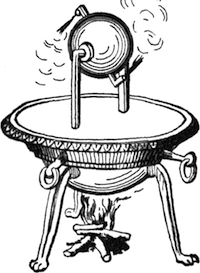
The aeolipile was never put to any practical use, and the power of steam was not harnessed until the development of piston engines and, more recently, the steam-driven turbines that generate most of our electricity. But the aeolipile is recognized as the spiritual forerunner of them all, and it is even featured on the US Navy's Boiler Technician rating badge.
 So it's surprising that there is no mention of Hero or his steam engine in a patent (8,117,824) issued last week to the Navy. Like the ancient aeolipile, the Navy's new invention is driven in circles by rotating jets of steam. Its z-shaped arm (52) even resembles the jets of the aeolipile.
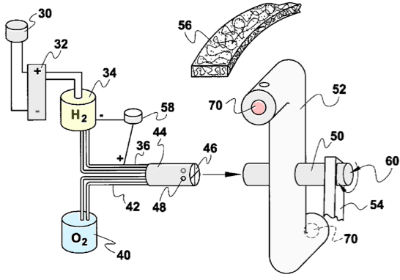
The difference is that in the new invention, steam is not generated by a boiler, it is generated by burning hydrogen. Hydrogen and oxygen combust to form high-pressure water vapor that jets out of the opposite ends (70) of the arm and causes the whole thing to spin around its axle (50).
Why bother to update Hero's steam engine, when it has proven relatively useless for two thousand years? The patent gives only the kind of stock answers that patent attorneys add when they have nothing better to say, like it has "a minimum of major moving parts." The aeolipile is just one of those timeless devices that never ceases to attract the attention of inventors. Even Robert Goddard, who built the first liquid-fueled rocket, patented (2,544,420) an aeolipile-like spinning rocket.
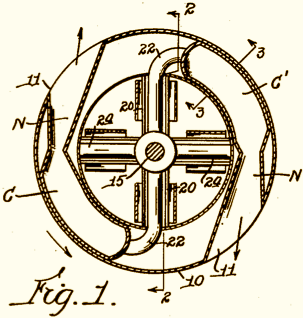 To Goddard, though, updating the aeolipile did not seem to be a priority: his patent application wasn't filed until two years after he died.


Comments