GazEtc

gazette cetera: clever patents, bright ideas, past and present

  • Home
  • Archives
  • Profile
  • Subscribe

New window is video screen on one side, clear on the other

A window can show a video image on one side but remain transparent from the other side using technology patented this week by San Francisco-based Emiscape. One use of the technology is to project advertisements onto the side of buildings without disturbing the occupants.

As described in the patent (8,123,365) and the company's Web site, a full-color image is displayed on a transparent screen using only particular wavelengths of red, green and blue light. The image can be projected onto the screen, or the screen itself can include transparent light-emitting diodes. The color image is visible from only one side of the screen (from the right, in the illustration). 

A filter on the other side of the screen blocks out precisely those same wavelengths of light, so a viewer on the filter side (the left) can't see the displayed image. But the filter is transparent to most of the remaining red, green and blue light. So a viewer can still see other objects through the screen without seeing the image. 

The filter technology is similar to that of the Dolby 3D system. In that system, 3D glasses use filters that pass only particular wavelengths of light to each eye while blocking the wavelengths destined for the other eye, but both eyes still see a full-color image.

Emiscape suggests that the screen can be used between the front and back seat of a car, where it would appear to be a full-sized video screen to backseat passengers but would remain transparent to the driver in front. It's a great idea, and maybe it would work at night, but Emiscape's conceptual video highlights one serious challenge: how do you project black?   
Posted by Jeff Steck on 03/01/2012 in New Inventions | Permalink | Comments (0)

Reblog (0) | | | |

Squeaky toy for accelerator pedal to improve fuel economy

A patent was granted yesterday for a sort of squeaky toy that fits under a car's accelerator pedal. The patent (8,122,843), issued to a team of inventors from Ohio, describes a device that wedges under the pedal and squeaks whenever the pedal is pressed down too quickly, encouraging a more mellow, fuel-efficient driving style. 

The hollow, rubbery device is shaped to fit under pedals of different height in different cars. A whistle (28) squeals if the driver really stomps on the gas, but the device still flexes under foot if rapid acceleration is really needed.

Remarkably, the idea of a whistling accelerator pedal is not new. In 1976, a patent (3,952,688) issued for a bellows that straps onto the gas pedal.


The bellows is attached to a "reed whistle or 'tweeter'" that squeaks when the pedal is pressed too quickly. The inventors of the new patent argue that their wedge-shaped device is less likely to slip out from under the pedal than the earlier bellows design. "Unfortunately, some drivers would be likely to try to kick it back into place while driving thereby creating a safety hazard."

Posted by Jeff Steck on 02/29/2012 in New Inventions | Permalink | Comments (0)

Reblog (0) | | | |

Tesla Tuesday: Vertical-takeoff airplane with swinging seat

Nikola Tesla was not fond of airplanes. In 1908, he predicted that airplanes would "never fly as fast as a dirigible balloon." The Zeppelin, he noted, travels at "a speed far in excess of those obtained with aeroplanes." Tesla calculated (somehow) that airplanes would never be much faster than boats. In short, airplanes are too slow.  

Later, Tesla criticized airplanes for being too fast. To take off and land, they require an "indispensable high velocity, imperilling life and property." And while the "helicopter" had been proposed in theory, Tesla calculated (again) that a helicopter would prove "incapable of proceeding horizontally along a straight line."

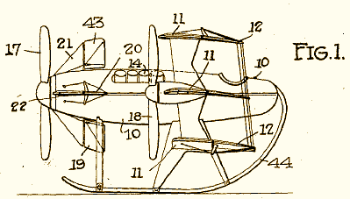
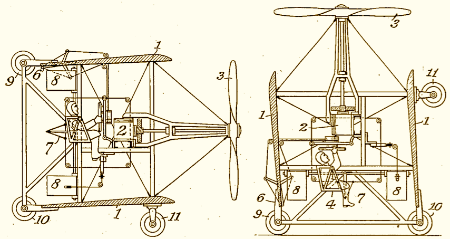
So Tesla patented (1,655,113) his own flying machine, early VTOL (vertical takeoff an landing) design. He envisioned a machine that would take off with the propeller pointed upwards, like a helicopter, and then transition to horizontal winged flight.

Voila_Capture331A ride in Tesla's aircraft would have been vertiginous: the pilot and passengers sit next to one another in swinging seats that pivot to remain vertical, much like the seats in a Ferris wheel.  

But by the time Tesla conceded that airplanes might be useful after all, he was already behind the times. Four years before Tesla filed his own patent application, Albert Zahm, a versatile inventor with the Curtiss Aeroplane and Motor Corp.,  had come up with essentially the same idea. 

Voila_Capture332The airplane described in Zahm's patent (1,358,603) rocks backward on a set of skids (44), so that it can take off vertically like a helicopter. And where Tesla, who never designed a working aircraft, casually suggested that "the tail is omitted or, if used, it is retractable," Zahm's airplane adopts a canard configuration, with the "tail" located in front of the pilot. Zahm's pilot may may need to lie on his back during takeoff, but Tesla's solution, the swinging seat, hardly seems like an improvement. 

Posted by Jeff Steck on 02/28/2012 in Old Inventions, Tesla Tuesday | Permalink | Comments (0)

Reblog (0) | | | |

US Navy re-invents ancient steam engine

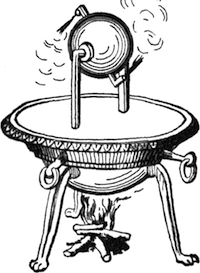
The US Navy has just patented a new twist on a two-thousand-year-old technology. The first steam engine, the aeolipile, was developed in the First Century by Hero of Alexandria. It was driven around a circle by rotating jets of steam.

Aeolipile_illustration

The aeolipile was never put to any practical use, and the power of steam was not harnessed until the development of piston engines and, more recently, the steam-driven turbines that generate most of our electricity. But the aeolipile is recognized as the spiritual forerunner of them all, and it is even featured on the US Navy's Boiler Technician rating badge. 

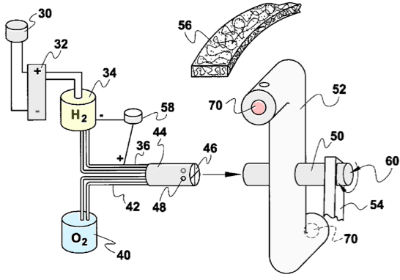
BT2So it's surprising that there is no mention of Hero or his steam engine in a patent (8,117,824) issued last week to the Navy. Like the ancient aeolipile, the Navy's new invention is driven in circles by rotating jets of steam. Its z-shaped arm (52) even resembles the jets of the aeolipile. 

Voila_Capture329

The difference is that in the new invention, steam is not generated by a boiler, it is generated by burning hydrogen. Hydrogen and oxygen combust to form high-pressure water vapor that jets out of the opposite ends (70) of the arm and causes the whole thing to spin around its axle (50).  

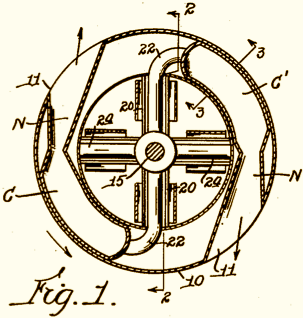
Why bother to update Hero's steam engine, when it has proven relatively useless for two thousand years? The patent gives only the kind of stock answers that patent attorneys add when they have nothing better to say, like it has "a minimum of major moving parts." The aeolipile is just one of those timeless devices that never ceases to attract the attention of inventors. Even Robert Goddard, who built the first liquid-fueled rocket, patented (2,544,420) an aeolipile-like spinning rocket.

Voila_Capture330To Goddard, though, updating the aeolipile did not seem to be a priority: his patent application wasn't filed until two years after he died.

Posted by Jeff Steck on 02/27/2012 in New Inventions, Old Inventions | Permalink | Comments (0)

Reblog (0) | | | |

Origami urinal

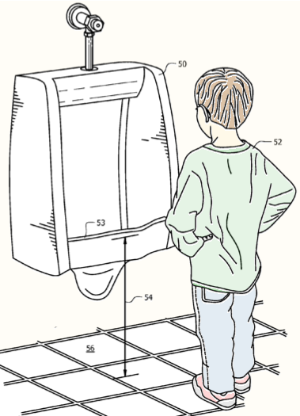
A patent issued this week for an origami urinal designed to address the plight, lovingly illustrated, of the boy who is too short for a standard urinal.

Voila_Capture325

"Damn."

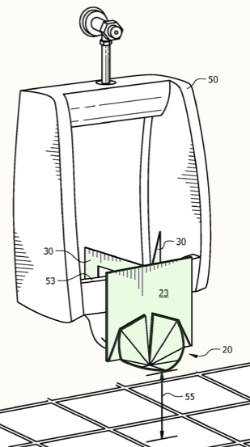
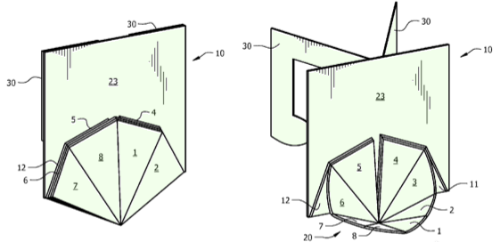
The patent (8,117,681) describes a folding cardboard urinal that can be hooked onto the edge of an existing urinal to provide a lower target.

Voila_Capture326

After use, it is tilted backward to empty its contents. The urinal is cleverly constructed out of a single sheet of cardboard. Until it is needed, it folds flat for convenient storage.

Voila_Capture328The hooks (30) can also attach the urinal to the edge of a toilet. Or, come to think of it, to a park bench. Or whatever else might be handy.

Posted by Jeff Steck on 02/24/2012 in Amusing Inventions, New Inventions | Permalink | Comments (0)

Reblog (0) | | | |

Electricity from giant submersible cold packs

Lockheed Martin received a patent this week on a new system of using the heat of ocean water to generate electricity. The system described in the patent (8,117,843) uses the temperature difference between warm surface water and cold deep water to drive a turbine. But instead piping in cold water all the way from the deep, the system lowers an enormous cold pack (212) to the frigid depths and raises it again when it has been sufficiently chilled. That way, Lockheed can make its own cold water (204) right at the surface.

The system is designed to overcome several of the difficulties of piping cold water to the surface.

First, it is difficult and energy intensive to pump cold water up from depths of 1000+ meters. This challenge is further exacerbated by the fact that cold water is more dense than warm water, which increases the energy required to draw it up to the surface. 

Second, deep water conduit 108 typically has a diameter within the range of 4 meters to 10 meters and a length of 1000+ meters. Such a conduit is difficult and expensive to manufacture. 

Third, the size and length of deep water conduits makes them susceptible to damage from environmental conditions, such as strong currents, storms, and wave action.

How big is each cold pack? Well, about a million tons each, twice the size of a big oil tanker. And to generate electricity continuously, you need at least a couple of them: one to generate electricity while the other chills in the deep. Come to think of it, the 1000 meter pipeline to the abyss might not be such a bad idea. 

Posted by Jeff Steck on 02/23/2012 in New Inventions | Permalink | Comments (0)

Reblog (0) | | | |

Happy Mardi Gras: Patent issued for automatic "bomb shot" machine

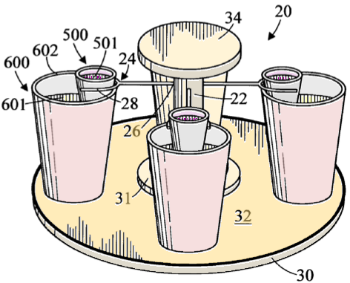
A new patent has issued in time for Mardi Gras: a drink tray that automatically makes "bomb shots." As explained in the patent (8,104,629):

A popular form of drinking is know[n] as "bomb shots". A bomb shot typically comprises a shot glass filled with some form of liquor, and a larger glass filled with another beverage. The shot glass is dropped into the larger glass and the combined beverages are then consumed. In one such drink called a "boilermaker", a shot glass full of whiskey is dropped into a partially filled glass of beer. 

The patent describes a tray with prongs that hold shot glasses above pint glasses. When you pull a pint glass from the tray, the shot glass slides off the ends of the prongs and falls into the pint.

Voila_Capture319

"When the shot glass strikes the bottom of the larger glass,
the carbonation of the beer causes a foaming action."

Since greater drinking efficiency has its hazards, the patent suggests that the shot glasses can be held to the bottom of the pint with magnets, so they won't "fall and strike the user in the mouth."

Posted by Jeff Steck on 02/21/2012 in Amusing Inventions, New Inventions | Permalink | Comments (0)

Reblog (0) | | | |

Tesla Tuesday: Lightning umbrella to replace lightning rod

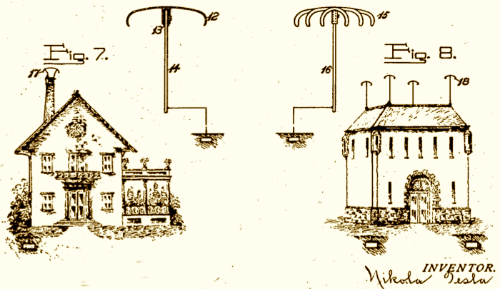
Around 1750, Benjamin Franklin invented the lightning rod, a sort of pointed metal decoy designed to be struck by a lightning bolt that might otherwise strike a more fragile part of a building. Nikola Tesla thought this was a terrible idea. The pointed end of Franklin's lightning rod, he argued, actually attracts bolts of lightning.

[T]he pointed lightning-rod is quite ineffective in the one respect noted, it has the property of attracting lightning to a high degree . . . . and in this feature lies the chief disadvantage of the Franklin type of apparatus.

Tesla set out to replace the pointed lightning rod, and in 1918, he received a patent (1,266,175) on his new design that was rounded rather than pointed: a lightning umbrella.

Voila_Capture318

"the probability of being struck is decreased by the presence of my protector,
whereas it would be increased by the presence of the Franklin rod"

Tesla believed that his new design was "equivalent to a repellent force" against lightning.

The improved protector . . . behaves in a manner just opposite to the Franklin type and is incomparably safer for this reason.

Later studies have shown that lightning strikes are essentially unpreventable, vindicating Franklin's design. If lightning is going to strike anyway, then you want a rod that attracts lightning, to keep the lightning from striking someplace where it might do significant damage. 

Posted by Jeff Steck on 02/21/2012 in Old Inventions, Tesla Tuesday | Permalink | Comments (0)

Reblog (0) | | | |

Pyrotechnic auto frame to improve crash safety

General Motors has received a patent (8,104,793) on a counter-intuitive technique of improving crash safety: lining the frame of the car with pyrotechnics. The patent, issued last month, describes the use of pyrotechnics in conjunction with shape-memory materials, such as nitinol. Such materials change shape instantly when exposed to heat.

Parts of a car's frame can be made of a shape-memory alloy (14) and lined with a pyrotechnic material (16). In case of a crash, the pyrotechnics are triggered, and the heat instantly bends the frame into a shape that will better protect the occupants of the car.

Perhaps overreaching a bit, the patent suggests that GM's pyrotechnic frame invention "can be employed in airplanes."

Posted by Jeff Steck on 02/20/2012 in New Inventions | Permalink | Comments (0)

Reblog (0) | | | |

Eccentric rock climbing nuts invent same

By the 1960s, before he founded the Patagonia sportswear company, Yvon Chouinard had already become an influential rock climber. Back then, the ropes used in rock climbing were often held up by pitons, metal spikes that were hammered into cracks. As described in a 1976 patent (3,948,485), Chouinard and his climbing partner, Tom Frost, realized that these spikes were damaging the natural features of the rock.

Although pitons are possibly the most well-known and widely used mechanical aid, the use of chocks has increased and the use of pitons has decreased during recent years, due to the interest in free climbing and because chocks are less likely to scar and flake the rock because they are wedged by hand into position in cracks and piton holes, rather than being driven with a hammer.

One jury-rigged alternative seemed less likely to damage the rock, but more likely to damage the climber:

Metal chocks for climbing evolved from the use of ordinary machine nuts collected alongside of the Snowdon Railway tracks as climbers hiked up the Clogwgn du'r Arddu.

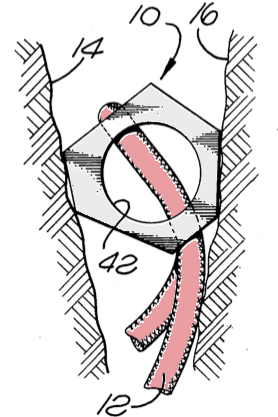
As an improvement over junked machine nuts, Chouinard and Frost designed an eccentric hexagonal nut for climbers, one that could wedge into cracks of two different sizes just by being tilted either to the left or to the right.

Voila_Capture314

"one such chock can take the place of two conventional chocks"

There is another benefit not mentioned in the patent, but described in Mountaineering: The Freedom of the Hills. Because the rope sling (12) does not point straight down, any downward force tends to rotate the nut, holding it more tightly in place with a "camming" action.

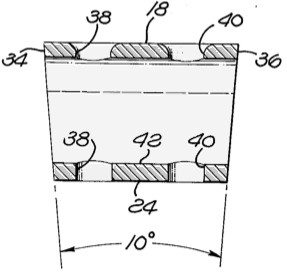
For still wider cracks, the nut can be turned crosswise: the ends of the hexagon, like the sides, also have a slight taper.

Voila_Capture315

It has been difficult to improve on such a simple, versatile design. Eccentric climbing nuts are still sold by Black Diamond, under the Hexentric trademark, to eccentric climbing nuts.

Posted by Jeff Steck on 02/19/2012 in Celebrity Inventions, Old Inventions | Permalink | Comments (0)

Reblog (0) | | | |

« Previous | Next »
Blog powered by Typepad
Jeff Steck
Jeff Steck
Subscribe to this blog's feed

Other Accounts

Facebook Twitter

Search

Recent Posts

  • Mother-son team patents cup holder for crutches
  • New invention makes applause louder, easier
  • Nike "air" technology in a baseball glove
  • Patent reveals dark side of pigeon racing
  • New IBM patent cracks down on lazy avatars
  • Regulation football has weighted strips for better spiral
  • Spanx inventor's billion-dollar panty patents
  • Eat clean food with dirty hands: sandwich bag has built-in glove
  • Champagne gift box doubles as ice bucket
  • Tesla Tuesday: Sparkless genius (Part I)

Categories

  • Amusing Inventions
  • Celebrity Inventions
  • Food and Drink
  • Games
  • New Inventions
  • Old Inventions
  • Sports
  • Tesla Tuesday
  • Web/Tech
  • Young Inventors
See More
  • Gazette Cetera
  • Powered by TypePad