By the 1960s, before he founded the Patagonia sportswear company, Yvon Chouinard had already become an influential rock climber. Back then, the ropes used in rock climbing were often held up by pitons, metal spikes that were hammered into cracks. As described in a 1976 patent (3,948,485), Chouinard and his climbing partner, Tom Frost, realized that these spikes were damaging the natural features of the rock.
Although pitons are possibly the most well-known and widely used mechanical aid, the use of chocks has increased and the use of pitons has decreased during recent years, due to the interest in free climbing and because chocks are less likely to scar and flake the rock because they are wedged by hand into position in cracks and piton holes, rather than being driven with a hammer.
One jury-rigged alternative seemed less likely to damage the rock, but more likely to damage the climber:
Metal chocks for climbing evolved from the use of ordinary machine nuts collected alongside of the Snowdon Railway tracks as climbers hiked up the Clogwgn du'r Arddu.
As an improvement over junked machine nuts, Chouinard and Frost designed an eccentric hexagonal nut for climbers, one that could wedge into cracks of two different sizes just by being tilted either to the left or to the right.
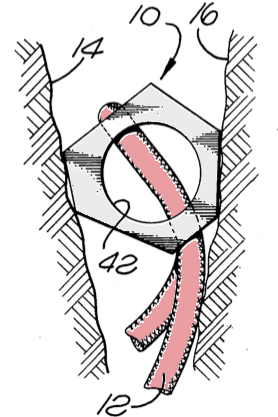
"one such chock can take the place of two conventional chocks"
There is another benefit not mentioned in the patent, but described in Mountaineering: The Freedom of the Hills. Because the rope sling (12) does not point straight down, any downward force tends to rotate the nut, holding it more tightly in place with a "camming" action.
For still wider cracks, the nut can be turned crosswise: the ends of the hexagon, like the sides, also have a slight taper.
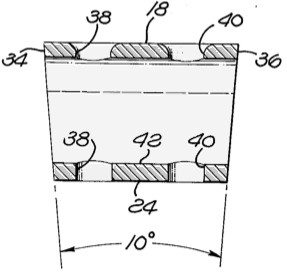
It has been difficult to improve on such a simple, versatile design. Eccentric climbing nuts are still sold by Black Diamond, under the Hexentric trademark, to eccentric climbing nuts.


Comments