Nikola Tesla became famous for his ability to generate enormous sparks of electricity. But his early successes, the inventions that would later finance the awe-inspiring scintillations of giant Tesla coils, were actually efforts to prevent sparks.
An electric motor turns because it is trying to keep up with magnetic fields that keep changing direction. And to change the direction of those fields, you need an electric current that keeps changing direction. Direct current (DC), the kind that comes from batteries, doesn't change direction by itself, so to keep a motor running on DC, the current has to be switched back and forth. The problem is that this constant switching can generate sparks, and those sparks eat away at the motor.
The same sparking problem can arise in electrical generators, which are fundamentally electrical motors run backward. (Boeing makes use of this in its regenerative landing gear invention.)
Tesla took on this sparking problem in his very first patent, issued in 1886. Perhaps for sentimental reasons, since he hadn't lived there for more than a decade, Tesla described himself in the patent as a resident of his birthplace, "Smiljan Lika, border country of Austria-Hungary."
As described in his patent (334,823), Tesla found that he could reduce sparking by overlaying the metal contacts (B) of the switches with an insulating layer (d) of mica or, better yet, asbestos paper.
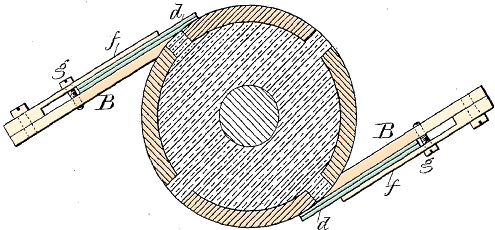
Covering the contacts with an insulator keeps sparks from jumping through the air, and electrical current flows only between those metal parts that are actually touching. Meanwhile, the asbestos paper doesn't just stop sparks: it also serves to "wipe and polish" the spinning parts of the motor.


Comments