Nikola Tesla was not fond of airplanes. In 1908, he predicted that airplanes would "never fly as fast as a dirigible balloon." The Zeppelin, he noted, travels at "a speed far in excess of those obtained with aeroplanes." Tesla calculated (somehow) that airplanes would never be much faster than boats. In short, airplanes are too slow.
Later, Tesla criticized airplanes for being too fast. To take off and land, they require an "indispensable high velocity, imperilling life and property." And while the "helicopter" had been proposed in theory, Tesla calculated (again) that a helicopter would prove "incapable of proceeding horizontally along a straight line."
So Tesla patented (1,655,113) his own flying machine, early VTOL (vertical takeoff an landing) design. He envisioned a machine that would take off with the propeller pointed upwards, like a helicopter, and then transition to horizontal winged flight.
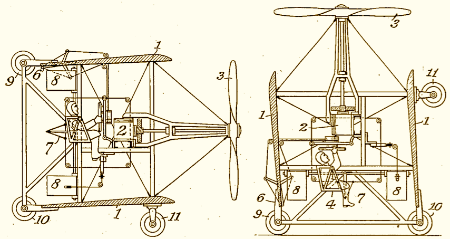 A ride in Tesla's aircraft would have been vertiginous: the pilot and passengers sit next to one another in swinging seats that pivot to remain vertical, much like the seats in a Ferris wheel.
But by the time Tesla conceded that airplanes might be useful after all, he was already behind the times. Four years before Tesla filed his own patent application, Albert Zahm, a versatile inventor with the Curtiss Aeroplane and Motor Corp., had come up with essentially the same idea.
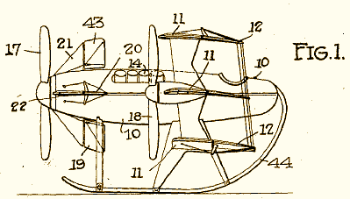 The airplane described in Zahm's patent (1,358,603) rocks backward on a set of skids (44), so that it can take off vertically like a helicopter. And where Tesla, who never designed a working aircraft, casually suggested that "the tail is omitted or, if used, it is retractable," Zahm's airplane adopts a canard configuration, with the "tail" located in front of the pilot. Zahm's pilot may may need to lie on his back during takeoff, but Tesla's solution, the swinging seat, hardly seems like an improvement.


Comments